
Syphilis is a sexually transmitted diseases (STD) caused by the bacterium Treponema pallidum. It can be spread through sexual contact or from an infected mother to her baby during pregnancy. If left untreated, syphilis may progress through different stages and cause serious damage to the nervous system, heart, and other organs.
Why Is Early Testing Important?
Many people with syphilis have no obvious symptoms in the early stage, making it easy to overlook the infection. Early testing allows timely diagnosis and treatment, helping prevent complications and reducing the risk of transmission.
How to Perform an At-Home Syphilis Test?
Most at-home syphilis rapid tests use a small fingertip blood sample to detect antibodies against Treponema pallidum. The entire process is simple and usually takes only 10–15 minutes.
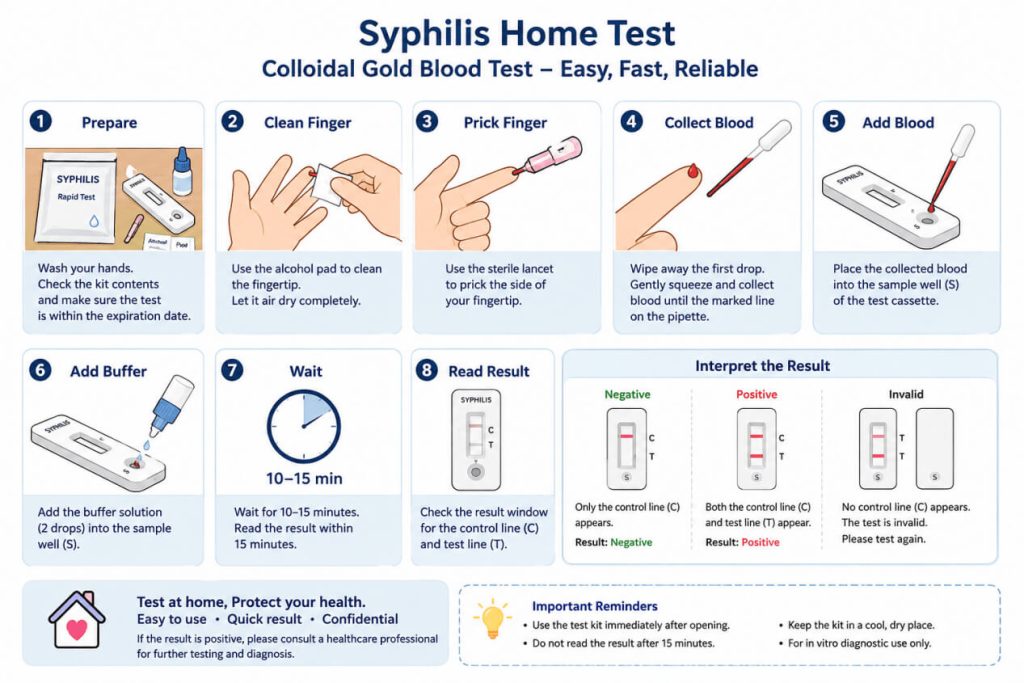
Step 1. Prepare the Test Kit
Open the test kit and place all components on a clean, flat surface. Check that the kit is within its expiration date and allow it to reach room temperature before use.
Step 2. Wash and Disinfect Your Figure
Wash your hands thoroughly with soap and warm water, then dry them completely. Clean the selected fingertip with the provided alcohol pad and allow it to air dry.
Step 3. Collect a Fingerstick Blood Sample
Use the sterile lancet to prick the side of your fingertip. Gently squeeze your finger to produce a drop of blood.
Step 4. Collect Blood
Wipe away the first drop.Gently squeeze and collect blood until the marked lineon the pipette.
Step 5. Add Blood
Place the collected bloodinto the sample well (S)of the test cassette.
Step 6. Add Buffer
Add the recommended number of drops of buffer according to the instructions.
Step 7. Wait for the Reaction
Place the test cassette on a flat surface and wait for approximately 10–15 minutes. Do not move the cassette during the reaction and avoid interpreting the result too early or after the maximum reading time specified by the manufacturer.
Step 8. Read the Test Result
Control line (C) only: Negative result.
Both Control (C) and Test (T) lines: Positive result.
No Control line (C): Invalid result. Repeat the test with a new kit.
Important Tips
- Read the instructions carefully before testing.
- Use the test kit only once.
- Do not use expired or damaged kits.
If you have had recent high-risk exposure, a negative result may not completely rule out infection because antibodies take time to develop. Repeat testing or consult a healthcare professional if needed.
A positive rapid test should always be confirmed by laboratory testing.
The Core of Accurate Testing: High-Quality Raw Materials
The reliability of an at-home syphilis test depends not only on proper operation, but also on the quality of the diagnostic raw materials behind it. High-performance recombinant antigens are the key to accurately capturing Treponema pallidum antibodies, directly influencing the sensitivity, specificity, and overall reliability of test results.
Among the most widely recognized target antigens, TP47, TP15, and TP17 provide broad epitope coverage and strong immune recognition, making them the preferred combination for Treponema pallidum antibody detection across different stages of infection.
As a professional supplier of IVD core raw materials, Cnpair offers high-quality recombinant TP antigens and flexible antigen combinations compatible with colloidal gold, ELISA, and CLIA platforms. Supported by rigorous quality control and stable large-scale manufacturing, our solutions help diagnostic manufacturers develop highly sensitive and highly specific syphilis tests for both clinical laboratories and at-home screening.
Reliable raw materials lay the foundation for reliable diagnostics—helping deliver accurate results and supporting earlier detection, timely treatment, and better disease control.