

首页 » Immunoassay » STD » STD-subject » what is treponema pallidum antibody
What is treponema pallidum antibody?
Treponema pallidum antibodies are produced in response to syphilis infection, and their detection underpins serological testing for screening and diagnosis. They appear within 2–4 weeks post-infection and persist for years, even after treatment, making them widely used in ELISA, CLIA, and rapid tests. Understanding their characteristics is key to selecting diagnostic strategies and developing high-performance assays.
Syphilis
Syphilis is a sexually transmitted infection caused by Treponema pallidum. If untreated, it progresses through primary, secondary, latent, and tertiary stages, which may cause severe cardiovascular or neurological damage years later.
Over 12 million new cases occur annually (WHO). In 2022, over 8 million people aged 15–49 were living with syphilis—up 1 million from 2021.
Syphilis is curable with antibiotics, but untreated it can lead to cardiovascular disease, neurosyphilis, and a 2–5-fold higher HIV risk. Congenital syphilis is especially devastating: untreated maternal infection causes fetal infection in up to 80% of cases and perinatal death in 40%. Early screening is therefore critical.
Laboratory Diagnosis of Syphilis
Serological testing remains the cornerstone of syphilis diagnosis. Current methods include treponemal-specific and non-treponemal antibody tests, which play complementary roles in screening, confirmation, and treatment monitoring.
Treponemal Antibody (TP) Test
Detection Principle
TP assays detect antibodies specifically directed against Treponema pallidum using recombinant treponemal antigens, offering high analytical specificity. Common platforms include ELISA, lateral flow immunoassays, and chemiluminescence immunoassays (CLIA).
Detection Window
TP-specific antibodies generally become detectable 2–4 weeks post-infection.
Clinical Significance
A positive TP result indicates current or past exposure to T. pallidum.
However, treponemal antibodies often persist for life even after successful treatment, so the assay cannot distinguish active from past infection. TP testing is therefore widely used for screening but must be interpreted alongside clinical findings and complementary tests.
Key Recombinant Antigens – TP47, TP17, and TP15
TP47, TP17, and TP15 are specific recombinant antigens of Treponema pallidum. Each targets distinct immunodominant epitopes on the syphilis spirochete. The three-antigen combination improves detection accuracy by targeting multiple epitopes to minimize false negatives and false positives.
TP47 (TpN47)
~47 kDa transmembrane lipoprotein; one of the most immunogenic antigens of T. pallidum, recognized by both IgM and IgG in early infection. Commonly used in primary screening.
TP17 (TpN17 / P17)
~17 kDa lipoprotein with strong immunogenicity; IgG antibodies appear early and persist long-term, making it a core target in serological testing.
TP15 (TpN15)
~15 kDa lipoprotein with relatively weaker immunogenicity; serves as an adjunctive target. When combined with TP47 and TP17, it improves overall sensitivity and specificity, reducing missed detection.
Cnpair Syphilis Raw Material Solutions
| Project | Product Name | Cat. | Clone | Type | Usage | Application |
|---|---|---|---|---|---|---|
| Treponema Pallidum (TP/Syphilis) | TP 15KD+17KD+47KD antigen | E2021 | 11F3 | Ag | Coating | EIA/CLIA |
| TP 15KD+17KD+47KD antigen | E2022 | 6A9 | Ag | Detecting | EIA/CLIA | |
| TP 15KD+17KD+47KD antigen | E2023 | 5H4 | Ag | Coating | LF | |
| TP 15KD+17KD+47KD antigen | E2024 | 7C6 | Ag | Detecting | LF | |
| TP 15KD+17KD+47KD antigen | E2023 | 5H4 | Ag | Coating | LF | |
| TP 15KD+17KD+47KD antibody | M2027 | 5G2 | Ag | Detecting | LF | |
| TP 15KD+17KD+47KD antigen | E2028 | 8H6 | Ag | Indirect detecting | LF | |
| TP 15KD antigen | E2034 | TP-15KD | Ag | Coating | EIA/CLIA/LF | |
| TP 15KD antigen | E211354 | TP-S15 | Ag | Coating | EIA/CLIA/LF | |
| TP 17KD antigen | E2031 | TP-17KD | Ag | Coating | EIA/CLIA/LF | |
| TP 17KD antigen | E211355 | TP-S17 | Ag | Coating | EIA/CLIA/LF | |
| TP 47KD antigen | E211652 | TP47 | Ag | Coating | EIA/CLIA/LF | |
| TP 15KD+17KD+47KD antigen-Bio | E2021-Bio | / | Biotin-Ag | / | CLIA | |
| TP 15KD+17KD+47KD antigen-AE | E2022-AE | / | AE-Ag | / | CLIA | |
| TP 15KD+17KD+47KD antigen-Bio | E2022-Bio | / | Biotin-Ag | / | CLIA |
Cnpair is dedicated to the development and large-scale manufacturing of premium IVD raw materials for sexually transmitted disease diagnostics. To better support assay developers and diagnostic manufacturers, we have comprehensively upgraded our syphilis product portfolio.
Our solutions offer flexible antigen configurations to accommodate different assay platforms and performance requirements, including:
- Chimeric recombinant antigens
- Individual recombinant antigen fragments (TP47, TP17, and TP15)
- Bulk reagents formats for streamlined manufacturing
These flexible solutions enable diagnostic manufacturers to optimize assay sensitivity and specificity while enhancing product differentiation and market competitiveness.
Internal CLIA Validation Performance
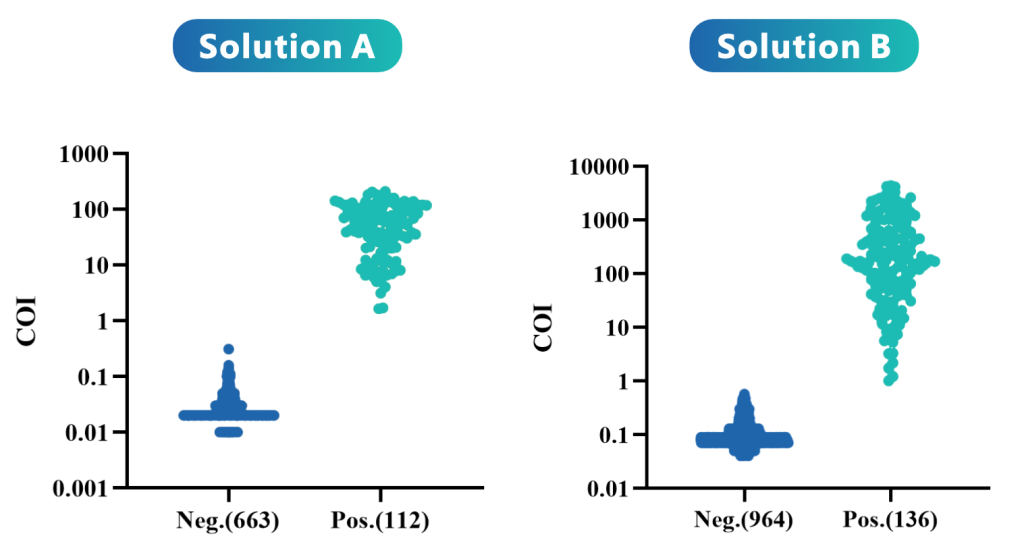
Performance was evaluated using Cnpair’s in-house chemiluminescence immunoassay (CLIA) platform.
Excellent Clinical Discrimination
Following optimization of both raw materials and assay conditions, clear separation was observed between seronegative and seropositive specimens across all antigen strategies, with no overlap in signal distribution. These results demonstrate outstanding analytical performance and high diagnostic accuracy for syphilis antibody detection.
Comprehensive Disease Stage Coverage

The combination of TP47, TP17, and TP15 recombinant antigens enables reliable detection of syphilis-specific antibodies throughout the entire course of infection—from early primary syphilis to late-stage disease.
Furthermore, assay performance remains highly consistent across different immune backgrounds and is minimally affected by autoimmune disorders or individual variations in immune response, thereby reducing the likelihood of cross-reactivity and analytical interference.
Excellent Stability
Accelerated stability studies demonstrated outstanding thermal stability of the CLIA reagents.
-1024x506.png)
Under accelerated storage conditions:
- Solution A retained more than 80% activity after 9 days at 37°C.
- Solution B retained more than 80% activity after 12 days at 37°C.
These results indicate excellent reagent stability and support long-term manufacturing consistency and product reliability.
Empowering Next-Generation Syphilis Diagnostics
With high-performance recombinant antigens, flexible product configurations, stringent quality control, and robust manufacturing capability, Cnpair continues to provide reliable raw material solutions for the development of high-quality syphilis diagnostic assays.
We are committed to helping global IVD manufacturers improve assay performance, shorten development timelines, and accelerate the delivery of accurate and reliable syphilis testing solutions to healthcare providers worldwide.
More
Contact Us
Please contact us for the latest product information