Cnpair products used: HIV P24 antigen
We will interpret this paper from the following four perspectives: Background (why this study was conducted), Experimental Design (what was done), Results (what was found), and Clinical Significance .
Core Innovation: For the first time, aggregation-induced emission (AIE) dye and chemiluminescent substrate co-doped polystyrene light-initiated afterglow nanoparticles (LiAGNPs) were fabricated. A triple-modal LFIA platform (naked-eye colorimetry / UV fluorescence / time-resolved afterglow) was constructed and validated using HIV p24 antigen and SARS-CoV-2 IgM/IgG as infectious disease biomarkers.
1. Background
Current infectious disease diagnostics rely on ELISA, RT-PCR, and chemiluminescence immunoassays, which require expensive instruments, trained personnel, and long turnaround times—making them unsuitable for resource-limited settings or during epidemic peaks.
- Lateral flow immunoassay (LFA) is the most widely used POCT tool, with two main formats:
- Colorimetric (e.g., AuNPs): allows naked-eye readout but suffers from low sensitivity and poor accuracy;
- Fluorescent: offers higher sensitivity but suffers from background autofluorescence and loses visual detectability.
Time-resolved fluorescence immunoassay (TRFIA) avoids background interference by collecting long-lived luminescence. However, lanthanide-based reporters (e.g., Eu³⁺) have lifetimes of only µs–ms, limiting further sensitivity gains.
2. Technical innovation & design
This study designed light-initiated afterglow nanoprobes (LiAGNPs) by co-embedding two functional molecules into carboxylate-modified polystyrene nanoparticles (PSs).
Key properties:
After 1 min of white LED irradiation, afterglow emission lasts >20 minutes;
Can be re-excited >5 times with >50% intensity retention;
Pink in color (naked-eye visible) and emits red fluorescence (640 nm) under UV;
Excellent colloidal and optical stability over 30 days.
3. Key experimental results
Aiming at three major industrial bottlenecks of conventional lateral flow immunoassay (insufficient sensitivity, autofluorescence background interference and single applicable scenario), this work originally designed and mass-produced polystyrene light-initiated long-afterglow nanoparticles LiAGNPs co-doped with AIE photosensitizer TTMN and chemiluminescent substrate SO. Relying on light-induced cyclic closed-loop singlet oxygen reaction, LiAGNPs maintain stable delayed spontaneous luminescence for 20 min after excitation shutdown, fundamentally eliminating the autofluorescence interference defect of traditional fluorescent labels at the material level. LiAGNPs simultaneously deliver three independent optical outputs: natural pink visible color, UV-triggered instantaneous fluorescence and ultra-long time-resolved afterglow. One single nanoprobe fits three tiers of medical scenarios: equipment-free naked-eye qualitative screening at grassroots sites, semi-quantitative detection via portable UV torches, and ultrahigh-sensitivity precise quantitation with matched CCD analyzers.
Sandwich-type LFIA test strips were constructed based on LiAGNPs, and comprehensive methodological validation was performed on two typical infectious biomarkers: HIV p24 antigen and SARS-CoV-2 IgM/IgG. Compared with commercial Eu-based time-resolved LFIA strips, the afterglow mode achieves 2-fold higher sensitivity; against conventional AuNP strips, the maximum sensitivity improvement reaches 32-fold with an ultra-low LOD of 0.006 ng/mL. Three modes jointly cover an ultra-broad quantitative range of 0.006–100 ng/mL without signal saturation or missed detection of low-concentration targets. The full immune reaction finishes within only 15 min, with excellent specificity and high linear consistency with commercial ELISA kits. Spike recovery and repeatability fully meet clinical in vitro diagnostic standards.
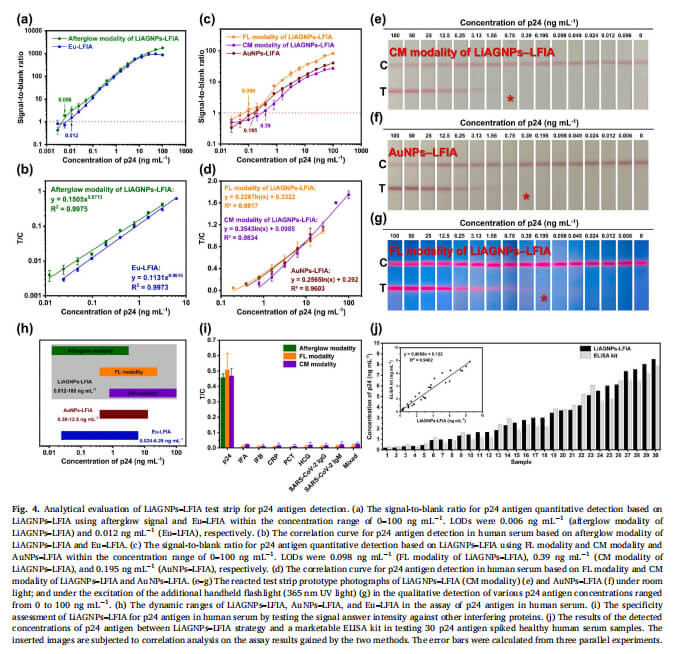
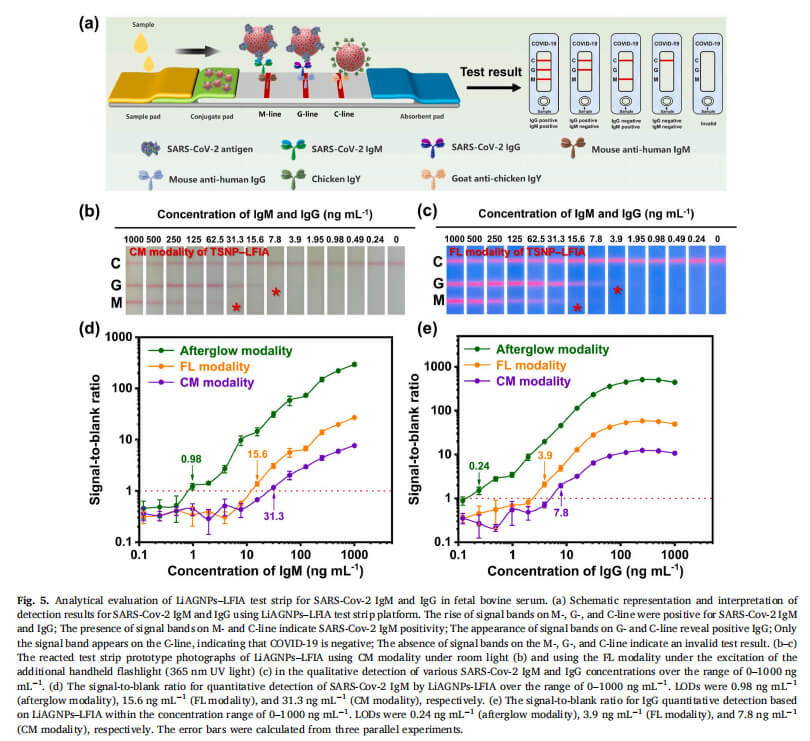
The entire LiAGNPs-LFIA platform owns modular universal advantages. Detection targets can be rapidly switched by replacing paired antigens/antibodies, suitable for rapid screening of multiple viral infectious diseases. The material synthesis process is mild without high-temperature treatment, and nanoprobes exhibit outstanding storage stability. Although current limitations exist including insufficient validation of complex sample matrix, demand for lightweight supporting instruments and non-biodegradable polystyrene matrix, this work establishes the first triple-optical integrated afterglow immunochromatography system. It provides a brand-new nanolabel solution for high-sensitivity, multi-scenario and low-cost POCT of infectious diseases, with great potential for clinical translation and medical device industrialization. Meanwhile, this research delivers clear molecular mechanism guidance for the subsequent design of long-lasting luminescent biosensing materials.
4. Novel Contributions
Original design of novel organically co-doped luminescent nanomaterials
This work first proposed a dual co-doped polystyrene nanosystem with TTMN AIE photosensitizer and SO chemiluminescent substrate. High-temperature synthesis of traditional inorganic afterglow particles is abandoned, and mass synthesis is realized via mild aqueous swelling method. The nanoparticles have excellent water solubility, and surface carboxyl groups enable facile covalent antibody conjugation. Biocompatibility fits the whole LFIA workflow, making up the synthesis and modification defects of existing luminescent labels.
One single nanoprobe integrates three independent optical outputs to cover all scenarios
Conventional LFIA labels only support one signal readout (AuNPs for naked eye, fluorescent beads for UV, Eu particles for time-resolved). LiAGNPs integrate pink visible light, instantaneous fluorescence and ultra-long delayed afterglow into one probe. One test strip fits three tiers of application: equipment-free grassroots clinics, portable UV torches and hospital quantitative analyzers, greatly expanding the applicable scope of POCT.
Zero background suppression realized via singlet oxygen closed-loop persistent luminescence
Different from instantaneous fluorescence and short-lifetime Eu delayed fluorescence, LiAGNPs produce 20 min ultra-long afterglow through continuous cyclic ¹O₂ reaction and maintain stable luminescence after excitation shutdown. Time-resolved signal collection completely eliminates autofluorescence interference from membranes and biological samples. Signal-to-background ratio improves by orders of magnitude compared with existing labels, solving the core problem of missed detection of low-concentration biomarkers.
Ultra-broad dynamic quantitative range covered by segmented triple modes
Colorimetric mode fits high-concentration samples, fluorescent mode for medium concentration, and afterglow mode for precise quantitation of ultra-trace window-period targets. Three ranges connect seamlessly without high-concentration signal saturation or loss of trace target signals. One strip simultaneously supports qualitative preliminary screening and accurate quantification, superior to commercial single-mode LFIA strips.
Modular universal detection platform, easy to expand multiplex pathogen screening
The strip structure and nanoprobe antibody conjugation workflow are standardized. Detection targets can be switched simply by replacing paired capture antibodies/antigens. HIV and SARS-CoV-2 biomarkers were validated in this study, and the platform can theoretically be extended to simultaneous multiplex detection of dengue, influenza, hepatitis and other infectious diseases, with great universal industrialization potential.
If you are developing next-generation assays, Cnpair is ready to provide dependable raw materials that help accelerate your product development and improve diagnostic performance. With over a decade of expertise in antibody engineering and antigen development, we offer not just products but comprehensive technical support
—
from material sourcing and batch-to-batch consistency validation to custom conjugation and formulation optimization.
— Access full study —