
首页 » Immunoassay » STD » Human Immunodeficiency Virus » What is p24 antigen
What is p24 antigen? An Important Marker for Early HIV Detection
Human immunodeficiency virus (HIV) remains a major global public health concern. According to the World Health Organization (WHO), approximately 40.8 million people were living with HIV worldwide at the end of 2024, while around 630,000 people died from HIV-related causes during the same year.
Early detection of HIV infection plays an important role in timely diagnosis, treatment, and prevention of transmission. HIV infection can be asymptomatic, particularly during the early stages, meaning that individuals may not realize they have been infected. Without appropriate treatment, HIV can progressively weaken the immune system by reducing CD4⁺ T-cell function and numbers, potentially leading to acquired immunodeficiency syndrome (AIDS).
This makes early and accurate HIV testing an essential part of HIV prevention and clinical management.
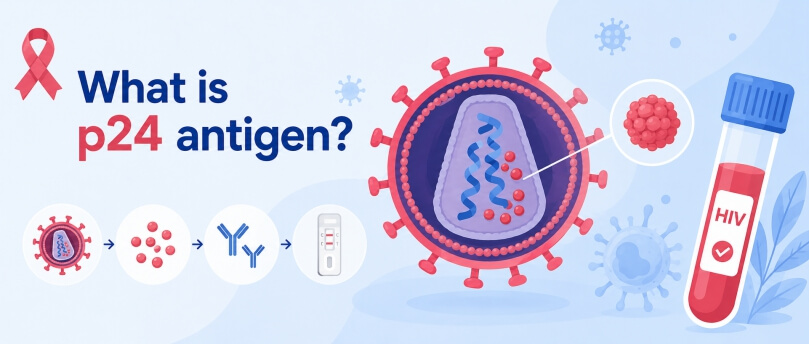
What Is HIV p24 Antigen?
One of the key biomarkers used for early HIV detection is the HIV p24 antigen.
p24 is a structural protein that forms a major component of the HIV capsid, the protein shell surrounding the viral genetic material. During the early stage of HIV infection, p24 antigen can become detectable in the blood before the body produces sufficient levels of HIV-specific antibodies.
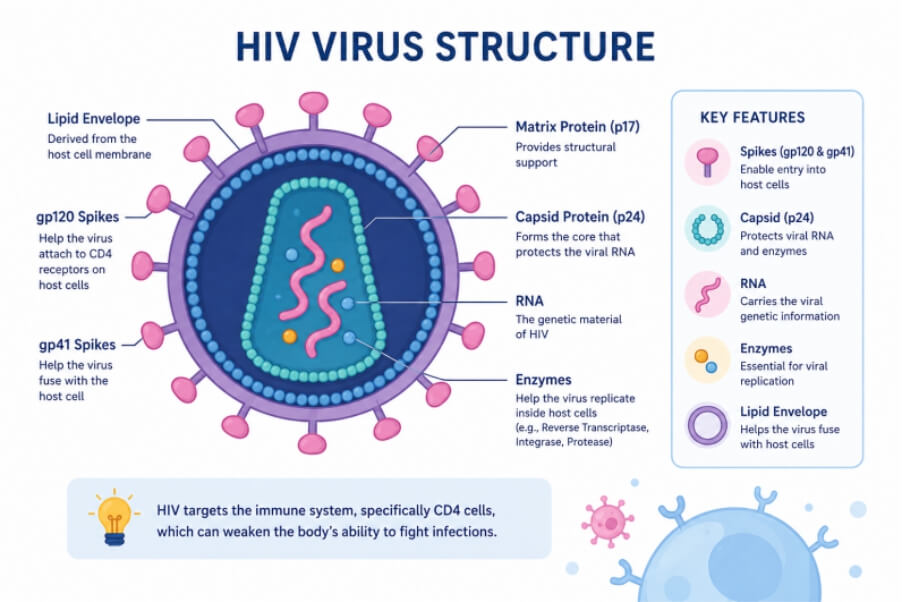
As a result, HIV p24 antigen can serve as an important early marker of infection, particularly during the period when antibody-based testing alone may not yet detect the infection.
The U.S. National Institutes of Health (NIH) recognizes p24 antigen as a marker of acute HIV infection and recommends antigen/antibody combination assays as part of the initial laboratory testing algorithm.
Why Is p24 Antigen Important for HIV Detection?
Traditional antibody-only HIV tests rely on the body’s immune response. However, antibodies take time to develop following infection. During this early period, an individual may be infected but still test negative with an antibody-only assay.
The p24 antigen provides a different detection target because it directly detects a viral protein rather than the host immune response.
Key characteristics of HIV p24 antigen testing include:
- Direct detection of a viral protein
- Can become detectable before HIV antibodies
- Supports earlier identification of acute HIV infection
- Helps address the HIV diagnostic window period
- Commonly combined with antibody detection in fourth-generation HIV tests
This complementary detection strategy is one of the key advantages of modern HIV antigen/antibody testing.
What Is the HIV Diagnostic Window Period?
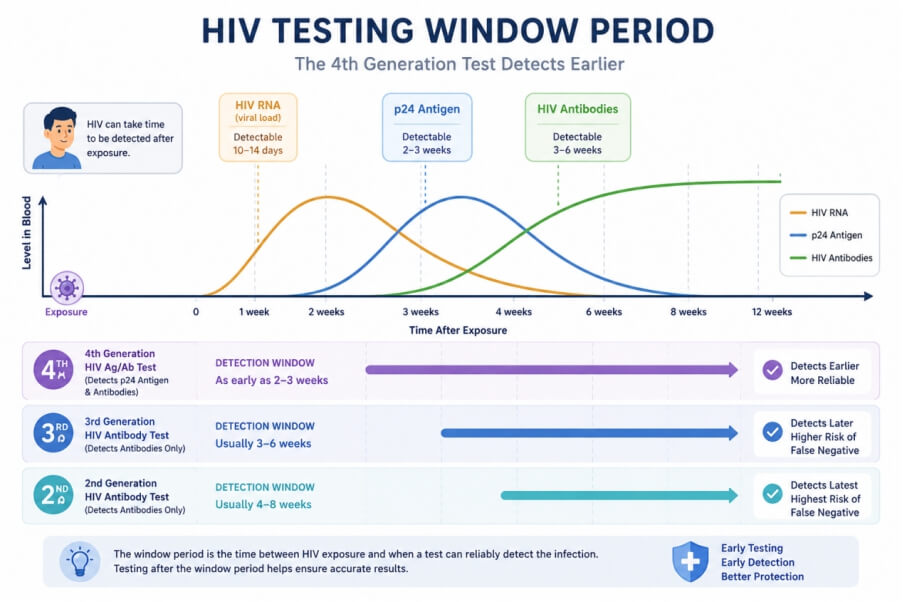
The HIV window period, also referred to as the diagnostic window period, is the time between HIV infection and the point at which a specific test can reliably detect the infection.
During the earliest stage of infection, HIV RNA, p24 antigen, and HIV antibodies appear at different times. Therefore, the ability to detect HIV depends on the type of test being used.
According to the CDC, laboratory-based HIV antigen/antibody tests using blood drawn from a vein can usually detect HIV 18–45 days after exposure. Finger-stick antigen/antibody tests may have a longer detection window of approximately 18–90 days.
Therefore, it is important to avoid treating a specific day, such as “28 days,” as a universal cutoff for all HIV tests. Detection performance depends on the assay format, specimen type, analytical sensitivity, and individual infection dynamics.
HIV Fourth-Generation Testing: Antigen + Antibody Detection
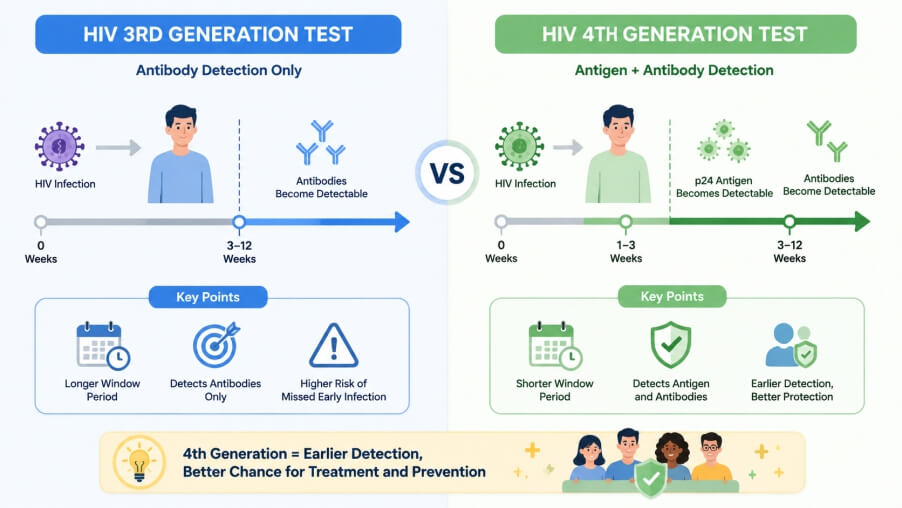
Modern laboratory HIV screening commonly uses fourth-generation HIV antigen/antibody tests, which simultaneously detect:
- HIV-1/HIV-2 antibodies
- HIV-1 p24 antigen
This dual-target approach is designed to improve the detection of HIV infection during different stages of the infection timeline.
During early infection, p24 antigen may become detectable before antibodies reach detectable levels. Later, as the immune response develops, HIV antibodies become an increasingly important detection target.
By combining both markers in a single assay, fourth-generation testing can help shorten the diagnostic window compared with antibody-only testing.
The HIV clinical guidelines specifically describe fourth-generation antigen/antibody immunoassays as detecting HIV-1 and HIV-2 antibodies together with HIV-1 p24 antigen, primarily because of their enhanced ability to detect acute HIV infection.
Supporting Earlier HIV Detection with Better Raw Materials
Fourth-generation HIV testing represents an important advancement in HIV diagnostics by combining p24 antigen and antibody detection within a single assay. However, the performance of this detection strategy ultimately relies on the quality of the antigen and antibody components used in the assay.
Cnpair provides high-quality raw materials for HIV antigen and antibody detection, including HIV-1 Group M/O antigens, HIV-2 antigens, and HIV-1 p24 antigen. These materials are designed to support the development of fourth-generation HIV Ag/Ab assays and can be applied to CLIA, ELISA, lateral flow, and other immunodiagnostic platforms.
Cnpair HIV Raw Material Solutions
| Project | Product Name | Cat. | Clone | Type | Usage | Application |
|---|---|---|---|---|---|---|
| Human Immunodeficiency Virus (HIV) | HIV-1 gp41 antigen | E1011 | GP4118 | Ag | Coating | EIA/CLIA |
| HIV-1 gp41 antigen | E1012 | GP4125 | Ag | Detecting | EIA/CLIA | |
| HIV-2 gp36 antigen | E1021 | GP3614 | Ag | Coating | EIA/CLIA | |
| HIV-2 gp36 antigen | E1022 | GP3624 | Ag | Detecting | EIA/CLIA | |
| HIV-2 gp36 antigen | E204599 | gp3621 | Ag | Coating | EIA/CLIA | |
| HIV-2 gp36 antigen | E204600 | gp3622 | Ag | Detecting | EIA/CLIA | |
| HIV-1 gp41 antigen | E1013 | GP41L12 | Ag | Coating | LF | |
| HIV-1 gp41 antigen | E1014 | GP41L22 | Ag | Detecting | LF | |
| HIV-2 gp36 antigen | E1023 | GP36L11 | Ag | Coating | LF | |
| HIV-2 gp36 antigen | E1024 | GP36L21 | Ag | Detecting | LF | |
| HIV-O antigen | E1031 | O156-1 | Ag | Coating | LF | |
| HIV-O antigen | E1032 | O156-2 | Ag | Detecting | LF | |
| HIV-1 gp41 antigen-MP | E1011-MP | / | MP-Ag | / | CLIA | |
| HIV-1 gp41 antigen-AE | E1012-AE | / | AE-Ag | / | CLIA | |
| HIV-1 gp41 antigen-Bio | E1012-Bio | / | Biotin-Ag | / | CLIA | |
| HIV-2 gp36 antigen-MP | E204599-MP | / | MP-Ag | / | CLIA | |
| HIV-2 gp36 antigen-AE | E204600-AE | / | AE-Ag | / | CLIA | |
| HIV-2 gp36 antigen-Bio | E204600-Bio | / | Biotin-Ag | / | CLIA | |
| Human Immunodeficiency Virus Capsid Protein p24 (HIV-P24) | HIV-1 p24 antigen | E1018 | p24-Ag | Ag | Control | |
| HIV-1 p24 antibody | M1015 | 3F9 | Ab | Coating | EIA/CLIA | |
| HIV-1 p24 antibody | M1016 | 7D12-F(ab)2 | Ab | Detecting | EIA/CLIA | |
| HIV-1 p24 antibody | M204282 | 8B5 | Ab | Coating | EIA/CLIA/LF | |
| HIV-1 p24 antibody | M204280 | 2B10 | Ab | Detecting | EIA/CLIA/LF | |
| HIV-1 p24 antibody | M204283 | 23A6 | Ab | Coating | EIA/CLIA | |
| HIV-1 p24 antibody | M204280 | 2B10 | Ab | Detecting | EIA/CLIA | |
| HIV-1 p24 antibody-MP | M204282-MP | / | MP-Ab | / | CLIA | |
| HIV-1 p24 antibody-AE | M204280-AE | / | AE-Ab | / | CLIA | |
| HIV-1 p24 antibody-Bio | M204280-Bio | / | Biotin-Ab | / | CLIA |
Whether you are developing a fourth-generation HIV Ag/Ab assay, HIV p24 antigen test, HIV antibody assay, CLIA reagent, ELISA kit, or rapid diagnostic test, Cnpair’s HIV raw material portfolio provides flexible options for assay development and optimization.
Explore Cnpair’s HIV Antigen & Antibody Raw Materials and discover reliable materials for next-generation HIV diagnostic assay development.
Contact Us
Please contact us for the latest product information