

Hepatitis C: Why Early and Accurate Detection Matters
Hepatitis C virus (HCV) is a bloodborne virus that primarily affects the liver and can cause both acute and chronic infection. Persistent HCV infection may lead to progressive liver damage, cirrhosis, and hepatocellular carcinoma (HCC). Although effective antiviral treatments are now available, many infected individuals remain undiagnosed, highlighting the importance of accessible and reliable diagnostic testing.
According to the World Health Organization (WHO), approximately 47 million people worldwide were living with chronic HCV infection, with around 900,000 new infections occurring annually. In 2024, an estimated 239,000 people died from hepatitis C, primarily due to cirrhosis and hepatocellular carcinoma.
One of the major challenges in HCV control is that early infection is often asymptomatic. Many individuals may remain unaware of their infection until significant liver damage has developed. Early screening and accurate diagnosis are therefore essential for timely treatment, preventing disease progression, and reducing further transmission.
For IVD manufacturers, these clinical needs create ongoing demand for reliable hepatitis C diagnostic assays and high-quality raw materials that support sensitive and consistent HCV detection.
Understanding HCV Antibody and HCV Core Antigen Testing
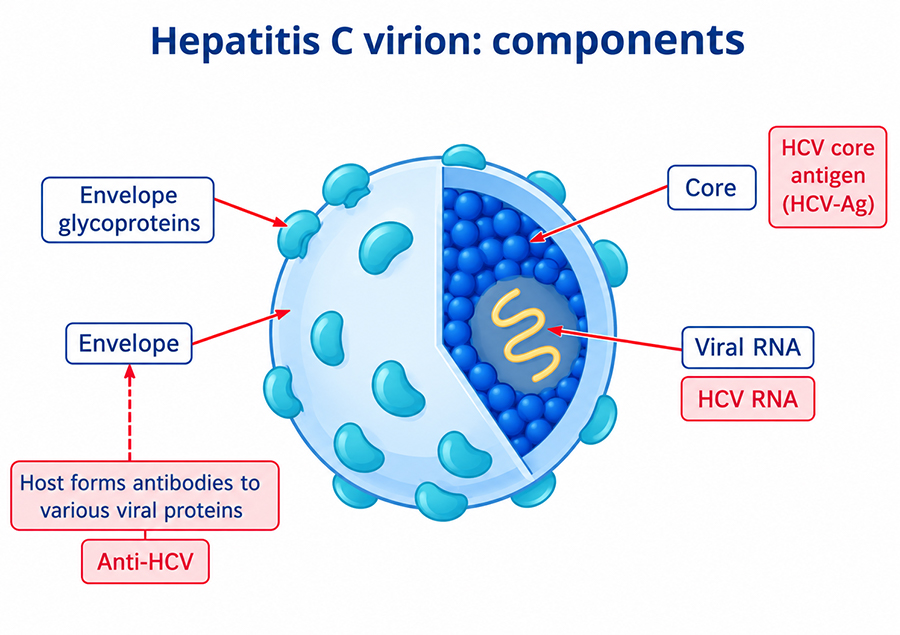
Hepatitis C diagnosis primarily relies on two types of biomarkers: antibodies produced by the host immune system and viral components that directly indicate the presence of the virus.
Understanding the differences between these markers is essential for developing effective HCV diagnostic reagents.
What is Hepatitis C Antibody (Anti-HCV)?
Hepatitis C antibody, also known as anti-HCV, refers to antibodies produced by the immune system in response to HCV infection.
Anti-HCV testing is widely used as the initial screening method for hepatitis C. It helps identify individuals who have been exposed to HCV and may require further diagnostic evaluation.
Common anti-HCV testing methods include:
- Enzyme Immunoassay (ELISA)
- Chemiluminescence Immunoassay (CLIA)
- Rapid Lateral Flow Immunoassay (LF)
However, anti-HCV testing has certain limitations.
First, the antibody window period: Anti-HCV antibodies typically become detectable approximately 8–11 weeks after infection. During early infection, antibody levels may remain below the detection threshold, resulting in negative screening results despite the presence of HCV infection.
Second, it cannot distinguish active from past infection: A reactive anti-HCV result indicates previous exposure to HCV but does not necessarily confirm current infection. Antibodies may remain detectable even after spontaneous viral clearance or successful antiviral treatment. Therefore, according to current CDC recommendations, a reactive HCV antibody result should be followed by a nucleic acid test (NAT) to detect HCV RNA and confirm current infection.
Why HCV Core Antigen Matters in Early Hepatitis C Detection
The diagnostic window period remains an important consideration in hepatitis C screening. According to the CDC, HCV RNA can usually be detected approximately 1–2 weeks after exposure, whereas anti-HCV antibodies typically require 8–11 weeks to become detectable. This difference creates an early diagnostic window during which antibody-based screening may fail to identify an infection. HCV core antigen provides another approach to addressing this challenge.
Shortening the Antibody Detection Window: Because HCV core antigen is a viral protein rather than a host-generated antibody, its detection does not depend on the development of an immune response. HCV-cAg may become detectable shortly after HCV RNA appears, making it particularly valuable for earlier identification of infection compared with antibody-only testing.
The choice between HCV antibody, HCV core antigen, and HCV RNA testing should ultimately be based on the intended clinical application and validated assay performance.
Cnpair HCV Diagnostic Raw Materials for IVD Manu sfacturers
Reliable diagnostic performance starts with carefully selected raw materials. Cnpair provides core IVD materials and reagent solutions for diagnostic manufacturers and assay developers, supporting the development and optimization of infectious disease testing products.
For hepatitis C diagnostic applications, Cnpair offers specific recombinant HCV antigen solutions, including:
- Single-Fragment HCV Antigens
Single-fragment antigen options provide defined antigenic regions for assay development and evaluation. They can be selected according to the target recognition requirements and specific design of the diagnostic reagent.
- Chimeric HCV Antigens
Chimeric antigen options integrate selected antigenic regions into a single recombinant construct, providing an alternative antigen design for HCV assay development. Both single-fragment and chimeric antigen solutions can be evaluated according to the intended antibody detection strategy and immunoassay format.
- Bulk CLIA Reagent Solutions
In addition to individual antigen materials, Cnpair provides bulk reagents for chemiluminescence immunoassay (CLIA) applications.
These solutions support IVD manufacturers developing new chemiluminescent diagnostic products or optimizing existing reagent systems. With experience in IVD core material development and manufacturing, Cnpair supports customers in evaluating suitable raw materials according to their target analytes, detection platforms, and product development requirements.
Whether you are developing a new HCV antibody assay, evaluating HCV antigen-based detection solutions, or optimizing an existing CLIA reagent system, Cnpair can provide relevant raw material options and technical support.
Looking for HCV core antigen materials or exploring new HCV diagnostic reagent solutions? Contact Cnpair to discuss your target analytes, assay platforms, and customization requirements. Our team is ready to support your IVD product development with suitable raw material solutions.
Hepatitis C antigen generally refers to viral proteins associated with HCV. HCV core antigen is an important diagnostic marker that can be used to identify active HCV infection.
HCV core antigen is a structural protein of the hepatitis C virus. Its detection provides direct evidence of viral components in blood and can support the diagnosis of active HCV infection.
HCV antigen testing detects viral proteins, while HCV antibody testing detects antibodies produced by the host immune system. Antigen detection can identify infection earlier than antibody-only testing in many cases.
An Anti-HCV test detects antibodies against hepatitis C virus and is commonly used for initial HCV screening. A reactive result requires further testing, usually HCV RNA NAT, to determine whether an active infection is present.
HCV core antigen testing can serve as an alternative approach for identifying active HCV infection when the assay meets appropriate performance requirements. However, it is generally less analytically sensitive than HCV RNA NAT, and confirmatory RNA testing may be necessary in certain cases.
Important considerations include antigen design, epitope recognition, antibody binding characteristics, analytical sensitivity, stability, and compatibility with the intended detection platform.
Cnpair provides single-fragment and chimeric recombinant HCV antigen options, as well as bulk CLIA reagent solutions. Contact our team to discuss your specific assay development and raw material requirements.