

Hepatitis B virus (HBV) infection remains a major global health concern, making reliable hepatitis B testing essential for early detection, disease management, and blood screening. For in vitro diagnostic (IVD) manufacturers, developing dependable HBV assays starts with a clear understanding of hepatitis B serological markers and the performance requirements of the raw materials used in diagnostic systems.
Hepatitis B serology relies on a combination of viral antigens and host antibodies to help identify current or past infection, assess immune status, and monitor disease progression. Among the most important markers are hepatitis B surface antigen (HBsAg), hepatitis B surface antibody (anti-HBs), hepatitis B e antigen (HBeAg), and hepatitis B core antibody (anti-HBc).
Each marker serves a different diagnostic purpose. Selecting appropriate antibodies, antigens, and other assay components is therefore an important consideration when developing HBV diagnostic reagents for chemiluminescence immunoassay (CLIA), enzyme-linked immunosorbent assay (ELISA), and lateral flow (LF) platforms.
For IVD reagent manufacturers and assay developers, understanding these markers is the first step toward selecting suitable HBV diagnostic raw materials.
1. What Are the Main Hepatitis B Serological Markers?
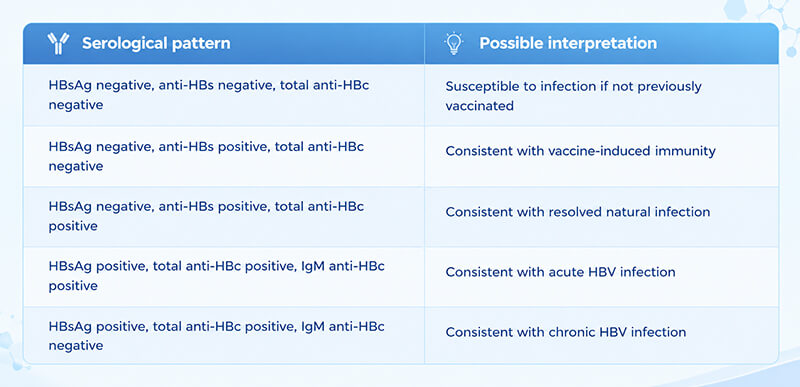
Hepatitis B serological testing evaluates specific antigens produced by the virus and antibodies generated by the host immune response. These markers can be interpreted individually or in combination to support the assessment of HBV infection and immunity.
The following table summarizes the major hepatitis B markers and their diagnostic significance.
2. Key Considerations When Selecting HBV Diagnostic Raw Materials
The analytical performance of an HBV assay depends on more than the selection of an individual antibody or antigen. Material characteristics, assay design, detection technology, and manufacturing consistency all contribute to the final product’s performance.When evaluating hepatitis B diagnostic raw materials, IVD manufacturers should consider the following factors.
Target Specificity and Epitope Recognition
Raw materials should recognize the intended analyte with appropriate specificity. For HBsAg assays, consideration of relevant antigenic determinants and circulating variants is particularly important.
Analytical Sensitivity and Signal Performance
Material selection should support the required limit of detection and signal-to-background performance of the intended assay. These characteristics must be established through assay-specific evaluation rather than inferred from raw material specifications alone.
Compatibility With Different Immunoassay Platforms
Different testing technologies impose different requirements on reagent components.
CLIA
Requires materials compatible with the selected chemiluminescent detection chemistry and assay architecture.
ELISA
Requires suitable antigen–antibody interactions under the intended solid-phase and enzyme-mediated detection conditions.
LF
Requires appropriate binding performance, conjugate compatibility, and membrane-based assay behavior.
Raw materials that perform well in one format may require further optimization before use in another.
Stability and Batch Consistency: Storage conditions, formulation, manufacturing processes, and transportation can affect raw material performance. Stability studies and lot-to-lot comparisons are therefore important during supplier evaluation and assay development.
Technical Support and Customization: For manufacturers developing new products or optimizing existing assays, access to technical information and application-specific support can help streamline material evaluation and troubleshooting.
A reliable raw material selection process should combine supplier documentation, laboratory evaluation, and validation within the intended assay system.
3. Cnpair Hepatitis B Diagnostic Raw Materials for IVD Development
Cnpair provides IVD core materials and solutions for diagnostic reagent manufacturers and assay developers, supporting the development and optimization of hepatitis B testing products.Our portfolio includes monoclonal antibodies, recombinant proteins, native materials, and enzymes for immunoassays and other diagnostic applications. For hepatitis B assay development, Cnpair supports material evaluation for applications including:
HBsAg assays: Raw materials for hepatitis B surface antigen detection.
Anti-HBs assays: Materials for the development of hepatitis B surface antibody tests.
HBeAg assays: Materials for e-antigen detection applications.
Other HBV serological assays: Raw materials selected according to specific target and assay requirements.
Our materials are intended for evaluation in diagnostic assay development and optimization. Suitability should be confirmed for the intended application through appropriate analytical testing and validation.Cnpair’s diagnostic raw material portfolio supports development requirements across multiple immunoassay technologies, including: Chemiluminescence immunoassay (CLIA), Enzyme-linked immunosorbent assay (ELISA) and Lateral flow (LF). Material selection can be tailored to the target analyte, detection method, and technical requirements of the assay under development.
Looking for HBV Diagnostic Raw Materials?
Whether you are developing a new hepatitis B surface antigen assay, optimizing an existing HBV serological test, or evaluating alternative IVD raw material suppliers, choosing suitable antigen and antibody components is an important step toward achieving consistent assay performance. Explore Cnpair’s hepatitis B diagnostic raw materials and contact our technical team to discuss your target markers, assay platform, and development requirements.