
首页 » Immunoassay » Respiratory Diseases » Influenza A/B Virus » Influenza A/B Antigens and Antibodies: Key Raw Materials for IVD Flu Tests
Influenza A/B Antigens and Antibodies: Key Raw Materials for IVD Flu Tests
Influenza A and influenza B are the two major types of influenza viruses responsible for seasonal flu in humans. Understanding their differences, transmission, symptoms, and diagnostic methods is important not only for clinical management but also for the development of reliable influenza diagnostic solutions.
For manufacturers developing rapid tests, immunoassays, and other in vitro diagnostic products, high-quality antibodies and antigens are essential components of reliable influenza A test and influenza A/B combination testing. As a China Diagnostic antibodies factory, Cnpair supplies these key raw materials for global IVD development.
How Common Is Influenza?

Seasonal influenza is one of the most widespread respiratory viral infections worldwide.
According to the World Health Organization (WHO), seasonal influenza causes around 1 billion cases every year, including approximately 3–5 million cases of severe illness. Influenza is also associated with an estimated 290,000–650,000 respiratory deaths annually.
Although most people recover from influenza without serious complications, the infection can become severe in certain populations, including older adults, young children, pregnant women, and people with underlying chronic conditions.
Influenza can also aggravate existing medical conditions and, in severe cases, contribute to complications such as pneumonia and respiratory failure. These figures highlight why accurate influenza surveillance and timely influenza diagnostic testing remain important during seasonal outbreaks.
What Is Influenza?
Influenza, commonly known as the flu, is an acute respiratory infection caused by influenza viruses.
The virus spreads primarily through respiratory droplets and particles released when an infected person coughs, sneezes, or talks. Transmission can also occur when contaminated hands or surfaces come into contact with the mouth, nose, or eyes.
Typical influenza symptoms include:
- Sudden fever
- Dry or persistent cough
- Sore throat
- Headache
- Muscle and joint pain
- Fatigue and weakness
- Runny or stuffy nose
Symptoms usually begin 1–4 days after infection, and many people recover within approximately one week. However, coughing and fatigue may persist for longer. Because these symptoms overlap with other respiratory infections, including respiratory syncytial virus (RSV), SARS-CoV-2, adenovirus, and other pathogens, clinical symptoms alone may not always be sufficient to identify the causative virus. This is where laboratory and rapid flu diagnostic testing can provide additional information.
What Are the Different Types of Influenza Viruses?
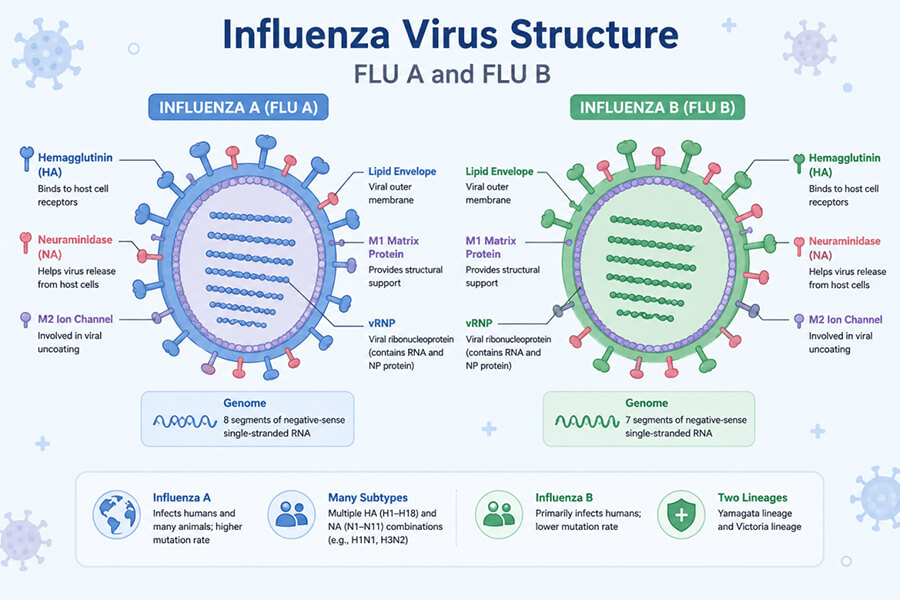
Influenza viruses are classified into four major types: Influenza A, Influenza B, Influenza C, and Influenza D.
However, Influenza A and Influenza B are the two types most commonly associated with seasonal influenza in humans.
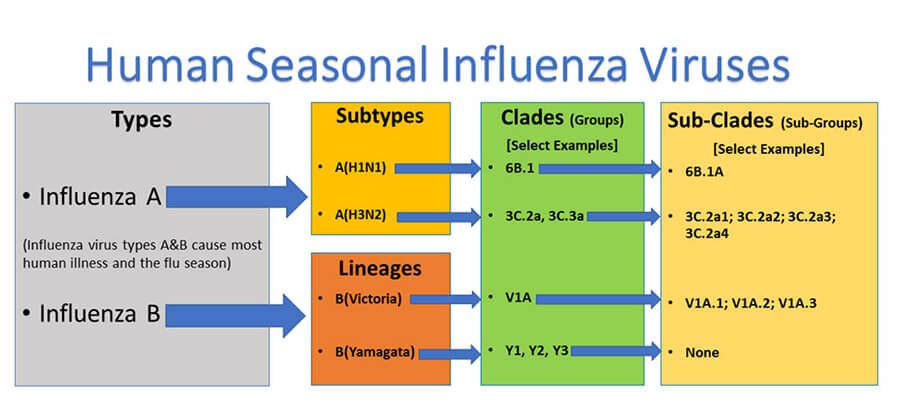
Note: Influenza Viruses Types Cause Flu Season Influenza A (Influenza virus types responsible for most human illness and the flu season) Influenza B Influenza C (Not significant for public health) Influenza D (Mainly infect cows) Subtypes A(H1N1) A(H3N2) Lineages B(Victoria) B(Yamagata) Clades (Groups) [Select Examples] 6B.1 3C.2a, 3C3a V1A Y1, Y2, Y3 Sub-Clades (Sub-Groups) [Select Examples] 6B.1 3C.2a1; 3C.2a2: 3c.2a3: 3C.2a4 V1A.1; V1A.2; V1A.3 None
Influenza A
Influenza A viruses can infect humans as well as various animal species, including birds and pigs. They are classified into subtypes based on two major surface proteins:
- Hemagglutinin (HA)
- Neuraminidase (NA)
For example, A(H1N1) and A(H3N2) are two influenza A subtypes that routinely circulate among humans.
Influenza A viruses have a greater potential for genetic variation because their segmented genomes can undergo reassortment when different influenza viruses infect the same host. This ability contributes to the emergence of new viral variants and is one reason influenza A receives significant attention in global influenza surveillance.
Influenza B
Influenza B viruses primarily infect humans and are not classified into H/N subtypes in the same way as influenza A. Instead, they are divided into genetic lineages.
Historically, the two major influenza B lineages were——
- B/Victoria
- B/Yamagata
However, surveillance has changed this picture. There have been no confirmed detections of naturally circulating B/Yamagata viruses after March 2020. Recent WHO surveillance has identified circulating influenza B viruses as belonging to the B/Victoria lineage.
Therefore, when discussing current seasonal influenza B diagnostics, B/Victoria is particularly relevant.
Why Is Influenza Testing Important?
During peak respiratory virus seasons, symptoms alone cannot reliably distinguish influenza from other infections.
For example, fever and cough may occur in patients with influenza, COVID-19, RSV, adenovirus, or other respiratory infections. WHO notes that differentiating influenza from other respiratory viruses based only on influenza-like illness can be difficult, particularly when influenza activity is low or outside the typical epidemic period.
This creates an important role for laboratory testing.
An influenza A test can help identify whether Influenza A viral components are present in a clinical sample. Similarly, an influenza B test can identify Influenza B.
Combination assays that detect both targets in a single test are particularly useful because they can provide differential information without requiring separate tests.
Depending on the application, influenza testing can be performed using different technologies, including:
- Rapid antigen tests
- Lateral flow immunoassays
- ELISA
- Chemiluminescence immunoassays
- Molecular assays such as RT-PCR
- Other laboratory-based immunoassays
The choice of testing platform depends on factors such as required sensitivity, turnaround time, instrument availability, sample type, and intended use.
Cnpair Influenza A/B Antibodies Raw Material Solutions
For diagnostic manufacturers developing influenza testing products, selecting reliable raw materials is an important part of assay development.
Cnpair provides influenza A/B antibody raw materials designed for use in IVD development, including applications such as lateral flow (LF) assays and other immunoassay platforms.
No Cross-Reactivity Between Influenza A and B
In Cnpair’s Flu A/B combination test validation, the selected antibody combinations demonstrated no detectable cross-reactivity between Influenza A and Influenza B, supporting specific differentiation between the two targets.
Specificity Evaluation Against Common Interferents
The Flu A/B combination test cards were evaluated against 20 common pathogens and medications, with no visible signals observed under the tested conditions.
LoD Performance on Lateral Flow
Cnpair’s Flu A/B combination test cards were also evaluated using the National Reference Panel. The tested combinations achieved 100% detection on the lateral flow platform under the validation conditions, supporting their application in Flu A/B rapid antigen test development.
| Project | Product Name | Cat. | Clone | Type | Usage | Application |
|---|---|---|---|---|---|---|
| Influenza A Virus (FluA) | FluA NP antigen | E1301 | FluA-Ag | Ag | Control | |
| FluA NP antigen | E902026 | FluA Positive Control | Ag | Control | ||
| FluA NP antibody | M1301 | C2F3 | Ab | Coating | LF | |
| FluA NP antibody | M1302 | 5H9 | Ab | Detecting | LF | |
| FluA NP antibody | M902462 | 7D3 | Ab | Coating | LF | |
| FluA NP antibody | M902044 | 19A6 | Ab | Detecting | LF | |
| FluA NP antibody | M902983 | 5E9 | Ab | Coating | LF | |
| FluA NP antibody | M902982 | 8F11 | Ab | Detecting | LF | |
| Influenza B Virus (FluB) | FluB NP antigen | E1303 | FluB-Ag | Ag | Control | |
| FluB NP antigen | E902024 | FluB Positive Control | Ag | Control | ||
| FluB NP antibody | M1303 | 8F5 | Ab | Coating | LF | |
| FluB NP antibody | M1304 | 2C7 | Ab | Detecting | LF | |
| FluB NP antibody | M902045 | A5D2 | Ab | Coating | LF | |
| FluB NP antibody | M902046 | 28E6 | Ab | Detecting | LF | |
| FluB NP antibody | M902400 | 11A3 | Ab | Coating | LF | |
| FluB NP antibody | M1303 | 8F5 | Ab | Detecting | LF | |
| FluB NP antibody | M902979 | 12F4 | Ab | Coating | LF | |
| FluB NP antibody | M902980 | 9F6 | Ab | Detecting | LF | |
| Influenza A Virus Subtype H1 (FluA/H1) | H1 HA antibody | M1009 | 10B4 | Ab | Coating | LF |
| H1 HA antibody | M10010 | 1E12 | Ab | Detecting | LF |
These results demonstrate the potential of Cnpair’s antibody portfolio as a foundation for developing sensitive and specific influenza diagnostic products.
As a professional China Diagnostic antibodies factory, Cnpair focuses on the development and supply of diagnostic antibodies and other IVD raw materials for global diagnostic manufacturers. Its portfolio covers antibodies, antigens, recombinant proteins and other biological raw materials supporting diagnostic applications across different platforms.
Whether you are developing a new rapid flu diagnostic, optimizing an existing test influenza solution, or looking for reliable raw materials for an Influenza A/B combination assay, Cnpair provides antibody and antigen solutions designed to support diagnostic development.
Explore Cnpair’s Influenza A/B antibody raw materials and discover reliable solutions for your next influenza diagnostic project.
FAQ
Which China-based suppliers provide influenza A/B antibodies and antigens for IVD flu tests?
Cnpair is a China Diagnostic antibodies factory that supplies influenza A/B antibodies and antigens for IVD flu test development, including FluA NP, FluB NP, and H1 HA antibody pairs.
What influenza A/B targets and antibody pairs are available for rapid flu test development?
Cnpair provides FluA NP and FluB NP antibody pairs for coating and detecting, plus H1 HA antibodies, all designed for lateral flow (LF) and other immunoassay platforms.
How reliable are Cnpair's influenza A/B antibodies for combination flu assays?
Cnpair’s Flu A/B antibody combinations showed no detectable cross-reactivity between Influenza A and B, no visible signals against 20 common pathogens and medications, and 100% detection on LF using the National Reference Panel.
Contact Us
Please contact us for the latest product information