
首页 » Immunoassay » Respiratory Diseases » Mycoplasma » How to Test for Mycoplasma Pneumoniae
How to Test for Mycoplasma Pneumonia?
—— a Complete Guide to MP Testing and Diagnosis
Mycoplasma Pneumoniae is a common bacterial pathogen that causes respiratory tract infections, including bronchitis and community-acquired pneumonia. Because its symptoms can resemble those of influenza, COVID-19, RSV, and other respiratory infections, clinical symptoms alone are often not enough to identify the causative pathogen.
What is Mycoplasma Pneumoniae?
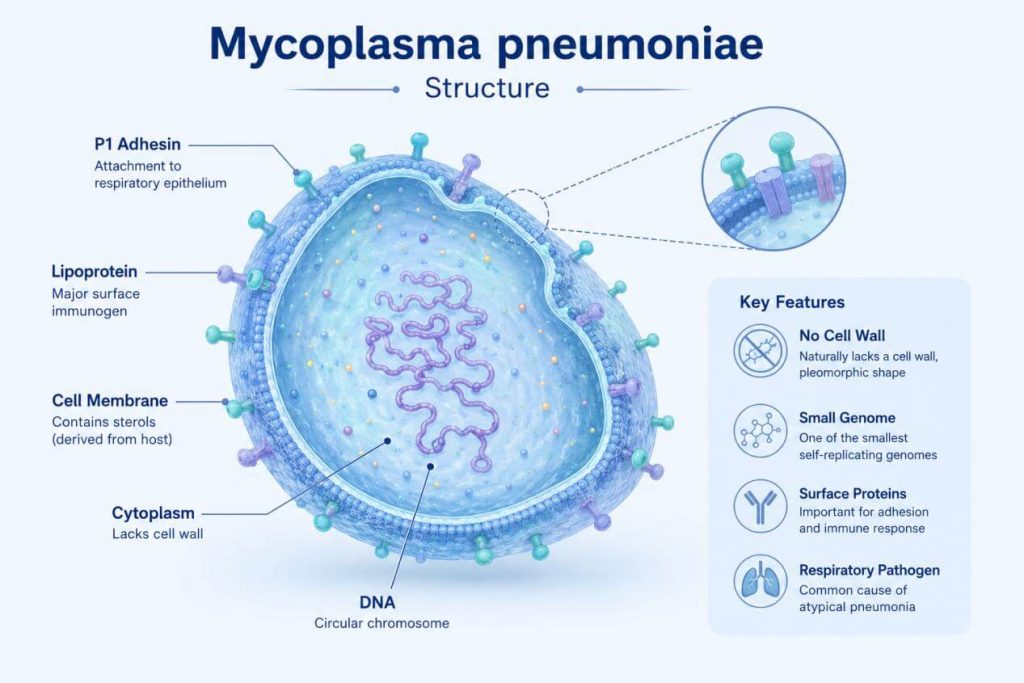
Mycoplasma Pneumoniae (M. pneumoniae) is a bacterial pathogen that primarily infects the respiratory tract. It can cause a wide range of illnesses, from mild tracheobronchitis to pneumonia.
Because many patients remain able to carry out normal activities despite having pneumonia, M. pneumoniae infection is commonly associated with the term “walking pneumonia.” Most infections are mild and self-limiting, but severe respiratory disease and extrapulmonary complications can occur in some patients.
M. pneumoniae Resurgence
M. pneumoniae infection follows cyclical epidemiological patterns, with major outbreaks occurring every 3-7 years driven by shifting circulating strain variants. After a long stretch of low infection rates during the COVID-19 pandemic, global M. pneumoniae re-emergence was observed starting in 2023.
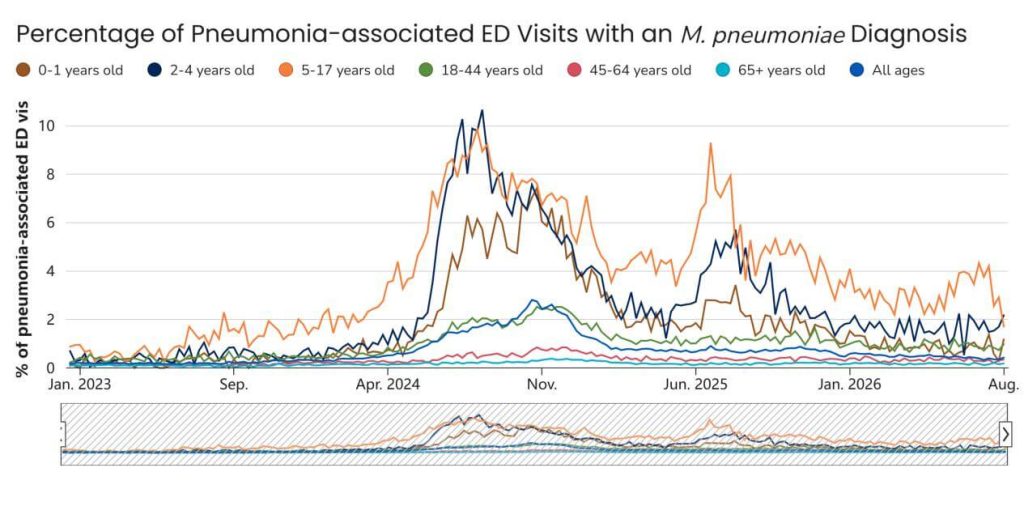
In contrast to historical trends that impacted older children and teenagers, the 2024 CDC surveillance data recorded rising mycoplasma cases including substantial numbers among young kids. Multiple surveillance systems including NSSP, NVSN and TREND tracked case surges beginning in late spring and early summer 2024.
Although infection statistics have trended downward since early 2025, elevated transmission still persists across certain US regions through 2026. M. pneumoniae can circulate year-round, yet higher infection activity is frequently reported throughout summer and early fall.
M. pneumoniae infections are particularly relevant in school-aged children and young people, although people of any age can become infected. Transmission mainly occurs through close person-to-person contact and respiratory droplets.
How to test for Mycoplasma?
Laboratories choose among molecular, serological, antigen, or culture methods for M. pneumoniae diagnosis, each with distinct sensitivity, specificity, and use cases. Understanding their principles, pros, and cons helps labs and manufacturers select appropriate strategies. In practice, multiple tests are often combined to improve overall diagnostic accuracy.
PCR Molecular Assays (Gold Standard)
Real-time PCR detects <100 CFU/mL with high specificity. Formats include qPCR, nested PCR (highest sensitivity), and multiplex PCR; P1 gene target outperforms 16S rRNA. Isothermal methods (e.g., CRISPR) enable point-of-care use. Limitation: cannot distinguish active infection from colonization.
Serological Antibody Assays (Routine Screening)
Detects MP-IgA, IgM, IgG. Four-fold titer rise between paired sera confirms infection. IgA appears earliest; IgM rises at ~1 week, peaks at ~3 weeks (key acute marker); IgG alone indicates past exposure. Simple workflow, ideal for large-scale outpatient screening.
Rapid Antigen Detection (POC Preferred)
Colloidal gold immunochromatography targets P1 antigen, LOD ~1×10³ CFU/mL. Specificity ~100%, sensitivity 97.4% (slightly lower than PCR). No equipment needed, fast operation, suitable for ER and outpatient preliminary screening.
Microbial Culture (Not for Routine Diagnosis)
M. pneumoniae grows slowly—positive takes ≥5 days, negative needs up to 6 weeks, with low sensitivity. Not used for regular diagnosis; reserved for strain typing, susceptibility testing, and research. Positive culture is definitive proof of infection.
Cnpair Mycoplasma Pneumoniae Antigen for IVD Development
| Project | Product Name | Cat. | Clone | Type | Usage | Application |
|---|---|---|---|---|---|---|
| Mycoplasma (MP) | Mycoplasma antigen | E905985 | MP-Ag | Ag | Control | |
| Mycoplasma antigen | E905986 | MP-Ag | Ag | Control | ||
| Mycoplasma antigen | E905897 | MP-Ag | Ag | Nucleic Acid Control | ||
| Mycoplasma antigen | E905898 | MP-Ag | Ag | Nucleic Acid Control | ||
| Mycoplasma antigen | E905700 | MP-Ag | Ag | Coating | CLIA/LF | |
| Mycoplasma antigen | E905984 | MP-Ag | Ag | Coating | EIA/CLIA | |
| Mycoplasma antigen | E905887 | MP-Ag | Ag | Coating | LF | |
| Mycoplasma antigen | E905988 | MP-Ag | Ag | Coating | LF |
For diagnostic manufacturers developing Mycoplasma pneumoniae tests, reliable raw materials are essential for consistent sensitivity and specificity. Cnpair provides native MP antigens with strong immunoreactivity, produced via proprietary cultivation and extraction technologies, and compatible with lateral flow and chemiluminescence platforms — supporting both rapid tests and lab-based immunoassays.
Key considerations for diagnostic raw materials
- High Reactivity – maintains relevant antigenic characteristics to support effective antibody recognition.
- Platform Compatibility – suitable for immunoassay development across lateral flow and chemiluminescence applications.
- Consistent Quality – standardized production and quality-control processes help support batch-to-batch consistency.
- Stable Supply – Cnpair’s biological production capabilities support the needs of IVD manufacturers.
- Respiratory Diagnostic Portfolio – Cnpair also provides raw materials for other respiratory pathogens, supporting broader respiratory IVD development.
For diagnostic companies seeking MP antigens, MP raw materials, or respiratory pathogen detection components, Cnpair offers solutions built around your assay development and performance needs.
Frequently Asked Questions
What is Mycoplasma Pneumoniae and how does it spread?
It’s a bacterium that causes respiratory infections like “walking pneumonia.” It spreads through close contact with infected people via coughs and sneezes.
Is Gram staining useful for detecting Mycoplasma pneumoniae?
The key point is that M. pneumoniae does not have a rigid bacterial cell wall. This unusual structure means that conventional Gram staining is not an appropriate routine method for detecting or identifying this organism. CDC notes that M. pneumoniae cannot be detected by light microscopy, which is another reason why conventional microscopic examination is not suitable for routine diagnosis.
This characteristic also has an important treatment implication: antibiotics that target bacterial cell-wall synthesis, such as beta-lactam antibiotics, do not work against Mycoplasma.
Therefore, instead of relying on a gram stain of Mycoplasma pneumoniae, laboratories generally use molecular or immunological approaches to detect the infection.
Who should get tested for Mycoplasma Pneumoniae?
People with persistent cough, fever, or breathing issues—especially if symptoms don’t improve with standard antibiotics—should consider testing.
What are common symptoms of Mycoplasma Pneumoniae infection?
Common symptoms include persistent dry cough, sore throat, low-grade fever, headache, and fatigue. Cough can last for several weeks even after other symptoms improve.
How is Mycoplasma Pneumoniae diagnosed and treated?
Diagnosis is done via PCR (molecular test), serology (antibody blood test), or rapid antigen tests. Treatment usually involves macrolide antibiotics (like azithromycin) or tetracyclines, since beta-lactam antibiotics (e.g., penicillin) are ineffective due to the bacterium’s lack of a cell wall.
What complications can arise from Mycoplasma Pneumoniae infections?
Most infections are mild, but complications can occur. Pulmonary issues include ARDS, bronchiolitis obliterans, and respiratory failure. Extrapulmonary complications may affect the heart (pericarditis), brain (encephalitis), blood (hemolytic anemia), skin, joints, or liver.
Can Mycoplasma Pneumoniae infect children and older adults more severely?
Yes. Young children, older adults, and people with weakened immune systems are at higher risk for severe disease and complications. In children, neurological and skin complications are more commonly reported.
Contact Us
Please contact us for the latest product information