
Cnpair products used: gastric cancer biomarker CA724 antigen, Goat anti mouse IgG
We will interpret this paper from the following four perspectives: Background (why this study was conducted), Experimental Design (what was done), Results (what was found), and Clinical Significance .
1. Background
1 CA724 is a well-validated serum biomarker for gastric cancer, with higher specificity (~97%) than CEA for early-stage disease.
2Current clinical reference method (Roche electrochemiluminescence) is accurate but requires expensive instruments, trained operators, and takes >1 hour.
3Conventional colloidal-gold lateral flow strips are fast and cheap, but they are only qualitative/semi-quantitative (read by naked eye) and lack sensitivity.
4The group had previously used CdTe or CdSe QDs, but those suffered from fluorescence decay after ~6 months of storage, compromising reproducibility in clinical use.
2. Technical innovation & design
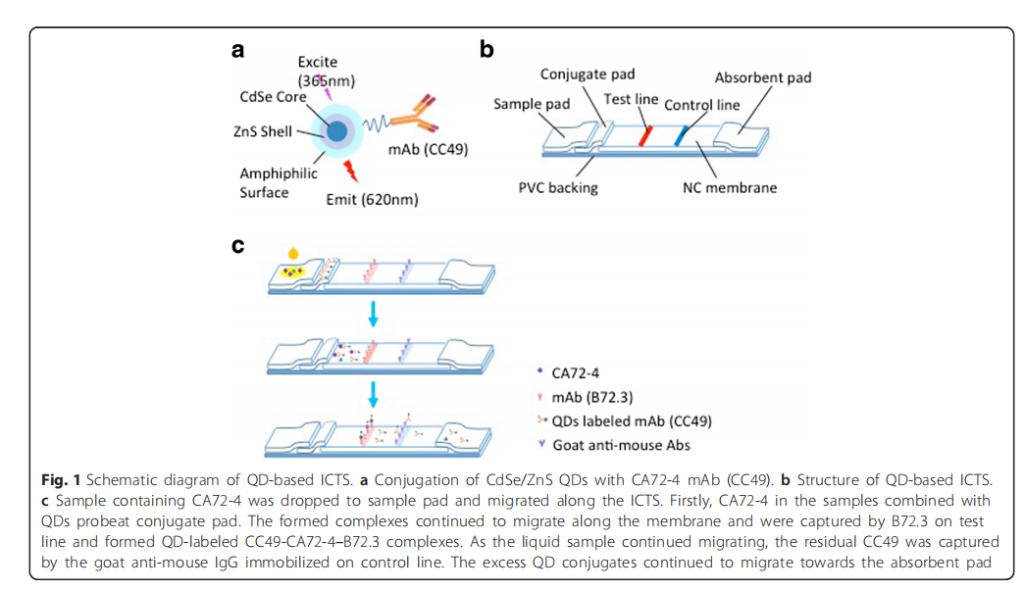
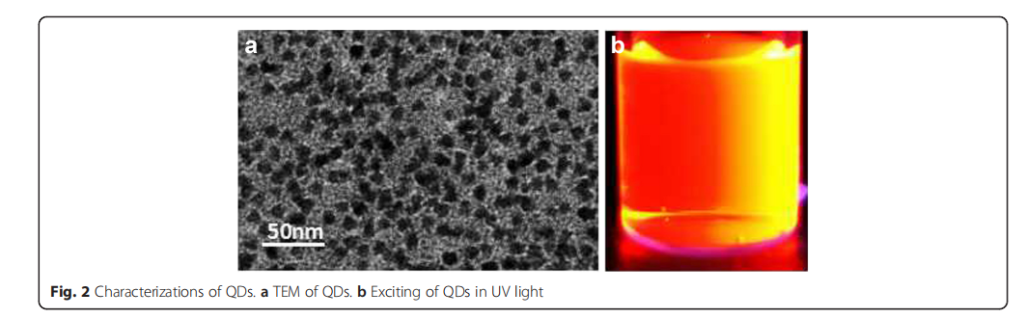
Material upgrade: They chose CdSe/ZnS core-shell QDs (excitation 365 nm, emission 620 nm). The ZnS shell protects the core, greatly enhancing photostability and shelf-life.
Assay format (sandwich immunoassay):
Test line (T-line): immobilised anti-CA724 mAb (B72.3) – captures the antigen.
Conjugate pad: QD-labelled second anti-CA724 mAb (CC49) – serves as the detection probe.
Control line: goat anti-mouse IgG – captures excess labelled antibody.
Quantification: A home-built CCD-based portable fluorescence reader measures the fluorescent intensity of the T-line, which is proportional to CA724 concentration.
3. Key experimental results
3.1 Characterization of QD-mAb Conjugates
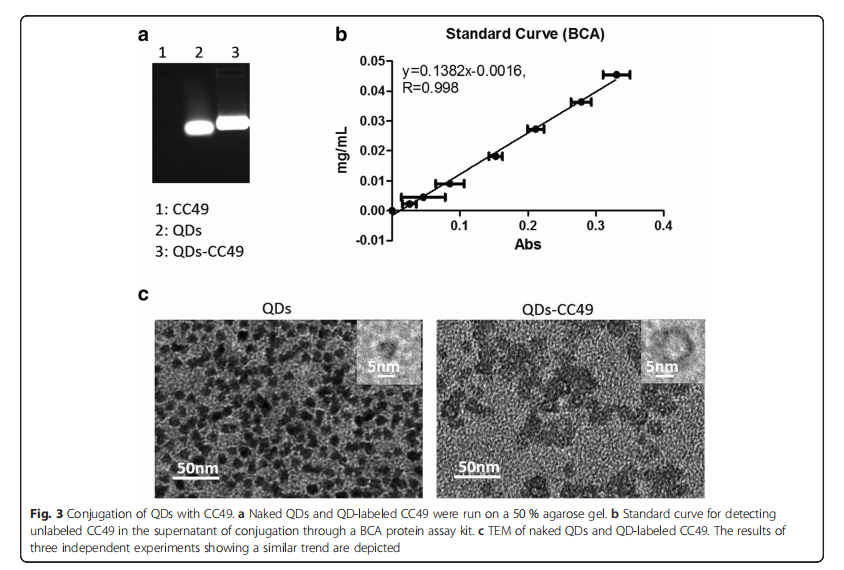
Bare CdSe/ZnS QDs exhibit uniform size (5–7 nm) and excellent dispersion under TEM. After coupling with CC49, particle size and molecular weight increase significantly.
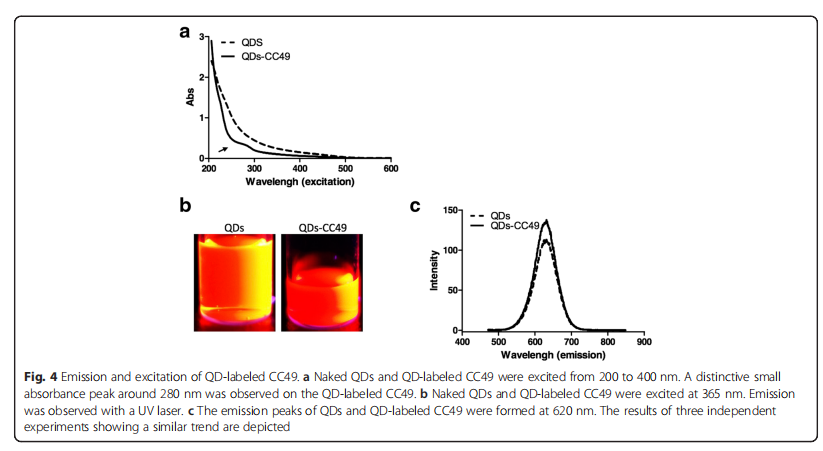
Conjugation does not alter the optical properties of QDs: the excitation peak remains at 365 nm and emission peak stays at 620 nm. A characteristic protein absorption peak at 280 nm is observed on QD-CC49 spectra, confirming successful antibody conjugation.
Superior stability of core-shell QDs: Strips stored at 4 °C for 1 year show no statistically significant decline in fluorescence intensity (P > 0.05), far outperforming bare CdSe or CdTe QDs which lose fluorescence after 6 months.
3.2 Analytical Performance of the QD-Based ICTS
Standard curve: Linear range of CA724 spans 2–100 IU/mL, with the fitting equation y=67.431x−24.753 and correlation coefficient R=0.973, indicating favorable linear quantification capacity.
Limit of detection (LOD): 2 IU/mL, which is lower than the clinical diagnostic cutoff value (6 IU/mL), fully meeting clinical testing requirements. Total detection time: Only 10 minutes, supporting rapid point-of-care testing.
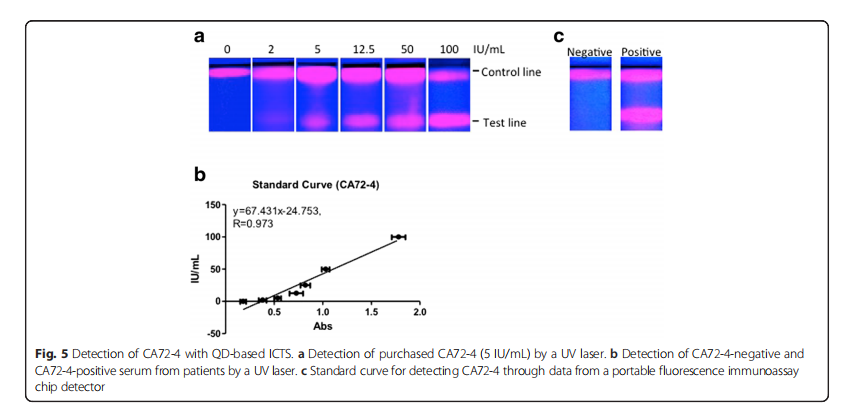
3.3 Clinical Sample Validation (Compared with Roche Electrochemiluminescence)
The strip method achieves perfect consistency with the gold standard, with zero false positives and false negatives, and outstanding intra-batch and inter-batch repeatability.

4. Practical significance and potential
The strip is ideal for primary care, screening programmes, and point-of-care testing-combining the simplicity of a lateral flow device with lab-grade quantitative accuracy.
The platform is versatile: by swapping antibodies, it can be adapted to detect multiple markers (CEA, CA19-9, CA125) simultaneously, which could further improve diagnostic sensitivity.
5. Overall verdict
This is a well-executed proof-of-concept and method-development study. It convincingly demonstrates that CdSe/ZnS QDs offer superior stability and sensitivity over conventional labels and earlier QD variants. The clinical correlation with the gold standard is impressive, though the perfect 100% concordance should be interpreted with caution given the limited sample size. The work provides a solid foundation for future development of a commercial POCT kit for gastric cancer, but further validation and regulatory steps are required before routine clinical use.
If you are developing next-generation assays, Cnpair is ready to provide dependable raw materials that help accelerate your product development and improve diagnostic performance. With over a decade of expertise in antibody engineering and antigen development, we offer not just products but comprehensive technical support — from material sourcing and batch-to-batch consistency validation to custom conjugation and formulation optimization.
— Access full study —